

A restaurant receipt gets folded into a wallet or left on the table without a second glance. But across Africa, that slip of paper does more work than the meal it describes. Read closely, it shows how a government has decided to pay for itself, line by line.
This is not a comparison of who charges the most. It is a look at what different tax systems reveal about six countries’ fiscal choices, from Accra to Johannesburg.
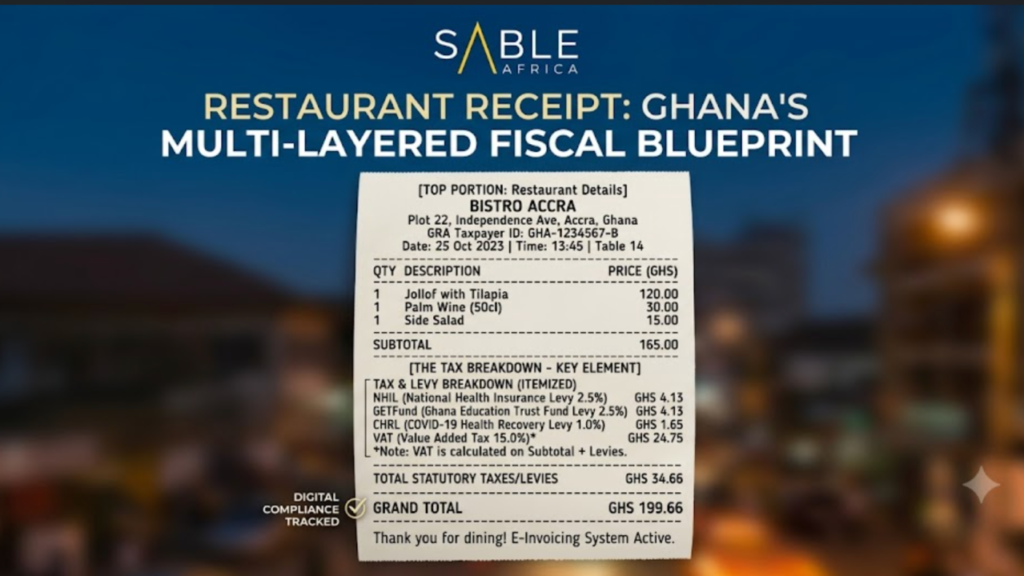
Ghana‘s bill carries four separate lines: 15 percent VAT, a 2.5 percent National Health Insurance Levy, a 2.5 percent GETFund Levy and a 1 percent Tourism Levy collected separately through the Ghana Tourism Authority, a combined 21 percent tied by name to healthcare, education and tourism. A January 2026 reform recoupled the first three onto the same tax base and scrapped a separate COVID-19 charge, trimming nearly two points off the VAT stack without touching the tourism levy or reducing what any fund collects.
Kenya charges 16 percent VAT plus a 2 percent Tourism Levy remitted by the restaurant to the Tourism Fund on gross sales above KES 3 million a year. Whether that levy shows up as its own line on a given receipt or is simply folded into the price varies by establishment, but either way it means two identical plates of ugali can carry different tax loads depending on the size of the kitchen, not the meal.
Uganda keeps the simplest receipt of the six: 18 percent VAT, one line, nothing earmarked. It is the only country here with no dedicated hospitality levy at all.
Rwanda also charges 18 percent VAT on food, but its 3 percent tourism tax, introduced in 2025, applies only to hotel rooms. A guest’s dinner and their room at the same hotel are taxed on entirely different logic.
Nigeria has the lowest headline VAT of the six at 7.5 percent, held there through a full rewrite of the tax code in 2025. But a Lagos diner can pay twice: the state has charged a separate 5 percent Hotel Occupancy and Restaurant Consumption levy since 2009, a tax federal authorities have spent over a decade in court calling unconstitutional. The dispute remains unresolved, and a Lagos receipt can carry close to 12.5 percent combined tax despite the lowest national VAT rate on this list.
South Africa holds a flat 15 percent VAT, a rate Treasury tried twice to raise in 2025 before a coalition partner’s legal challenge forced a reversal. The number on a South African receipt today is the same one that has applied since 2018.
Four models emerge from six receipts.
Ghana earmarks tax revenue to three separate public goods that show up by name on the bill. Uganda, Rwanda and South Africa keep it simple, a flat rate feeding general revenue with nothing itemised beyond VAT. Kenya and Rwanda both ring-fence a slice of hospitality spending for the tourism sector that generated it, though Rwanda applies it to rooms and Kenya to the whole bill. Nigeria stands apart, the lowest national rate paired with an unresolved argument between federal and state government over who gets to tax the same meal.
Set against the rest of the world, all six sit well inside a wide range. Denmark applies its full 25 percent VAT rate to a restaurant meal with no hospitality discount, the highest statutory tax on dining out anywhere with a general consumption tax, while diners in Hong Kong, Qatar and a handful of United States states pay nothing at all, because none of those places run a sales tax or VAT. Africa’s six receipts sit between those two poles, and the distance between them has less to do with the number on the bill than with what that number is built to fund.
None of this changes what arrives on the plate. But it changes who pays for what, and how visibly. A restaurant receipt is one of the only places an ordinary transaction shows a government’s fiscal philosophy in writing, and across Africa, six governments are writing six different answers.